

8th June update:
AIS Data Offers Clues to the MV Fugro Supporter’s Activities in the Falklands
Original Post
I’ve never indulged in speculation on OpenFalklands before, but I couldn’t let this opportunity pass. Why not, I said to myself? So yes, this post is total conjecture and pure speculation, but it is also interesting and fun.
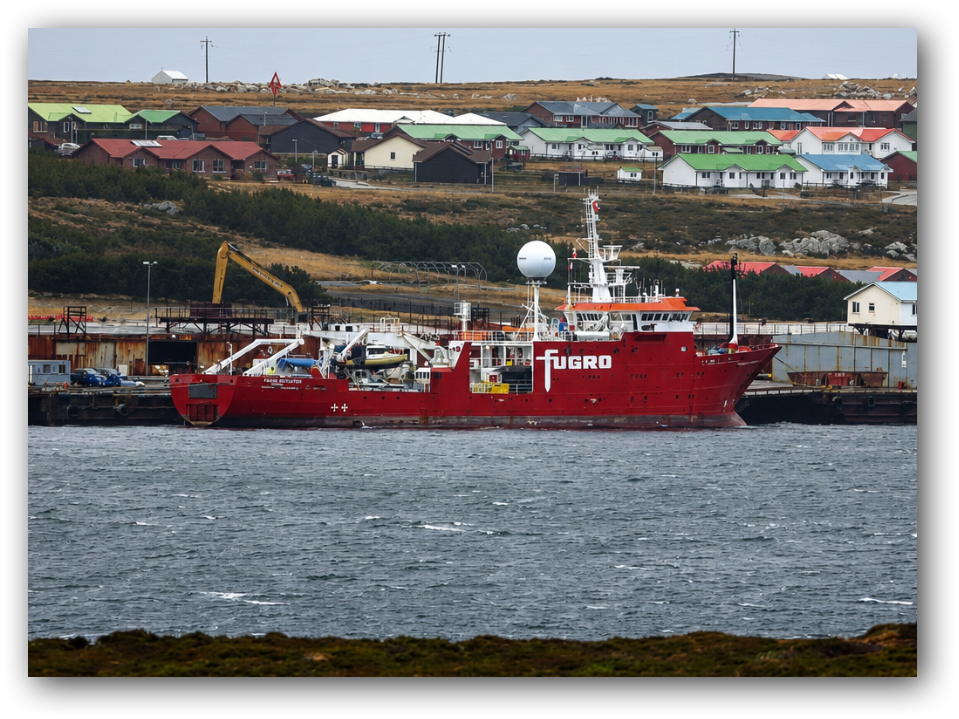
I came across this a few days ago when someone messaged me saying “that a cable survey vessel had been spotted just outside Stanley harbour.” “What’s its name?” I asked, and eventually I understood it to be the MV Fugro Supporter. So, before jumping headfirst into speculation, let’s start with the only facts we know.
MV Fugro Supporter visits the Falkland Islands
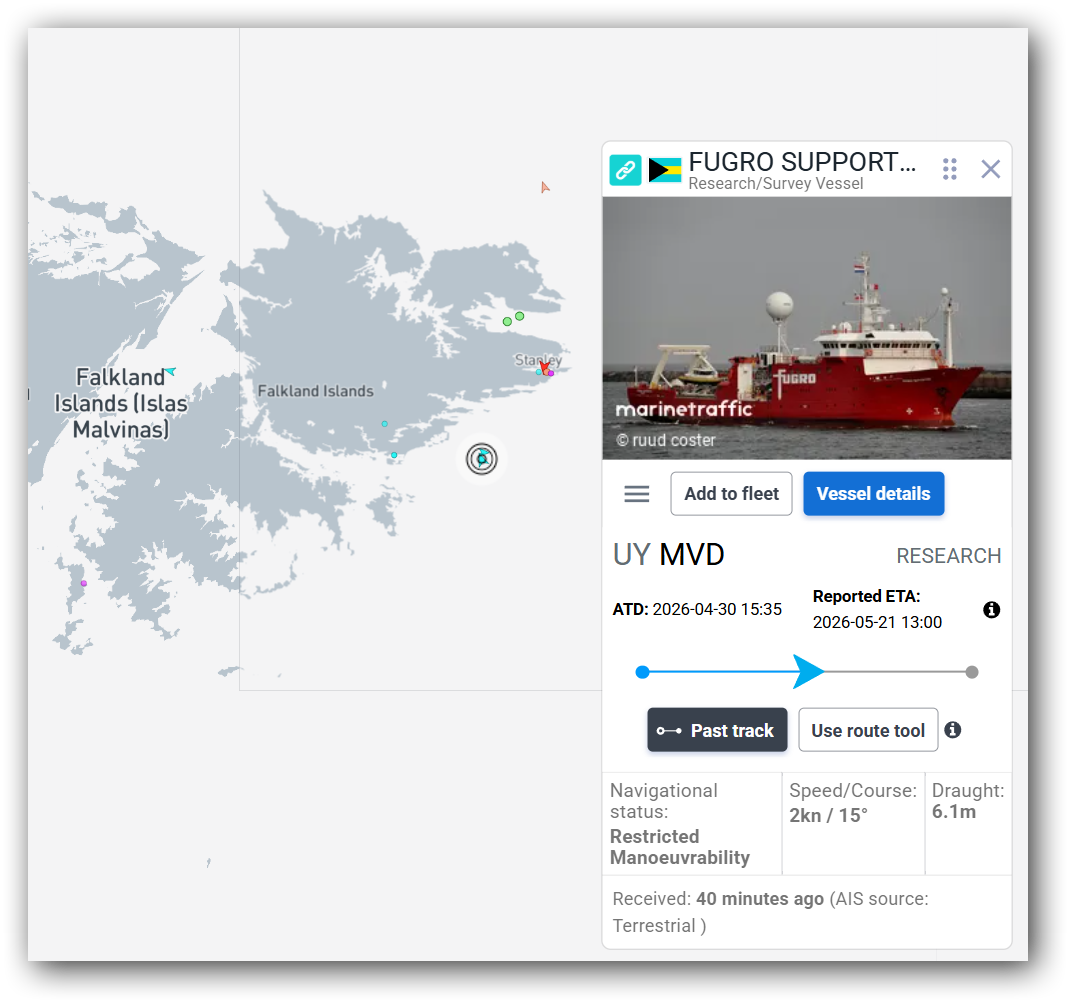
On June 1st 2026, I searched for the vessel on marinetraffic.com and found it at the location reported by sharp-eyed islanders.
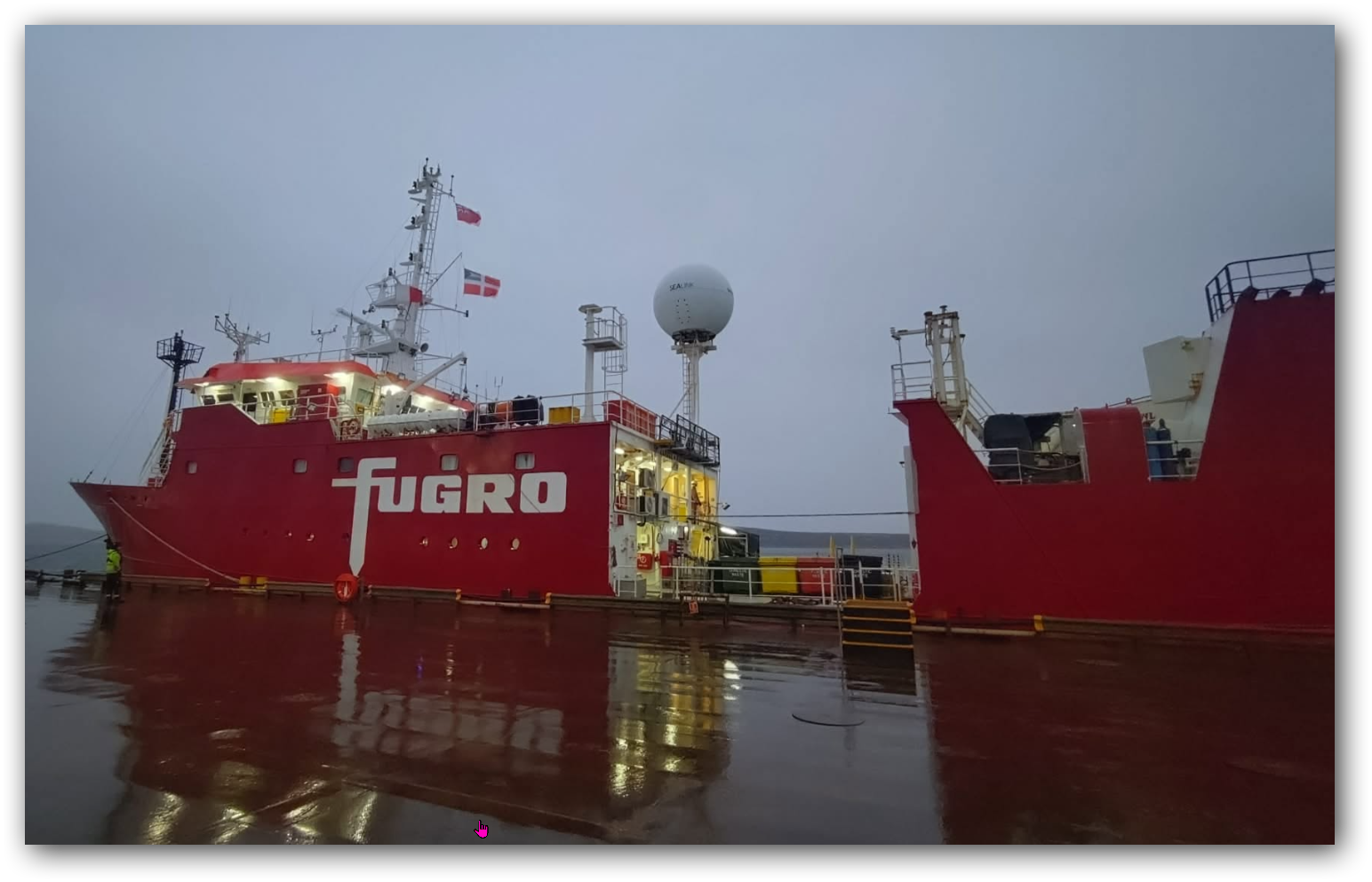
On June 5th, it was located in Stanley harbour:
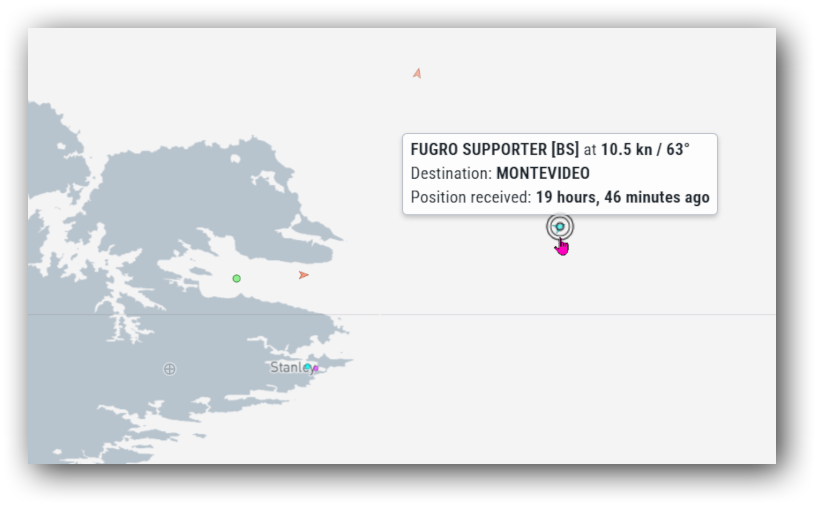
On June 6th it was seen returning to Montevideo.
Could this vessel be surveying for an undersea cable?
The MV Fugro Supporter is a specialist vessel used to collect detailed information about the seabed and the layers beneath it. While its primary business is supporting the offshore oil and gas industry through hydrographic, geophysical, and geotechnical surveys, the vessel is also capable of undertaking work in renewable energy, environmental studies, and subsea infrastructure projects, including telecommunications cables.
Consequently, although it could technically be used for a cable route survey, its presence alone does not indicate that such work is being carried out. An interesting question is whether the vessel will continue transmitting AIS data. Some vessels involved in defence or intelligence-related activities are not always publicly trackable, and it appears that the MV Fugro Supporter may have ceased transmitting.
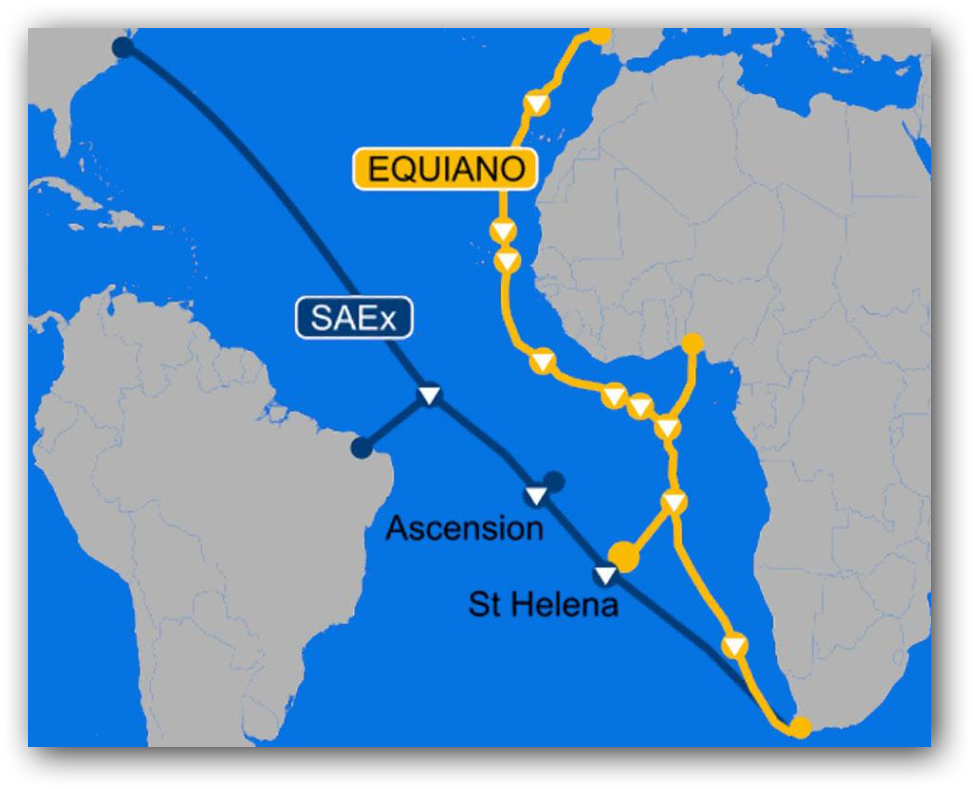
St. Helena’s Equiano Google undersea cable branch
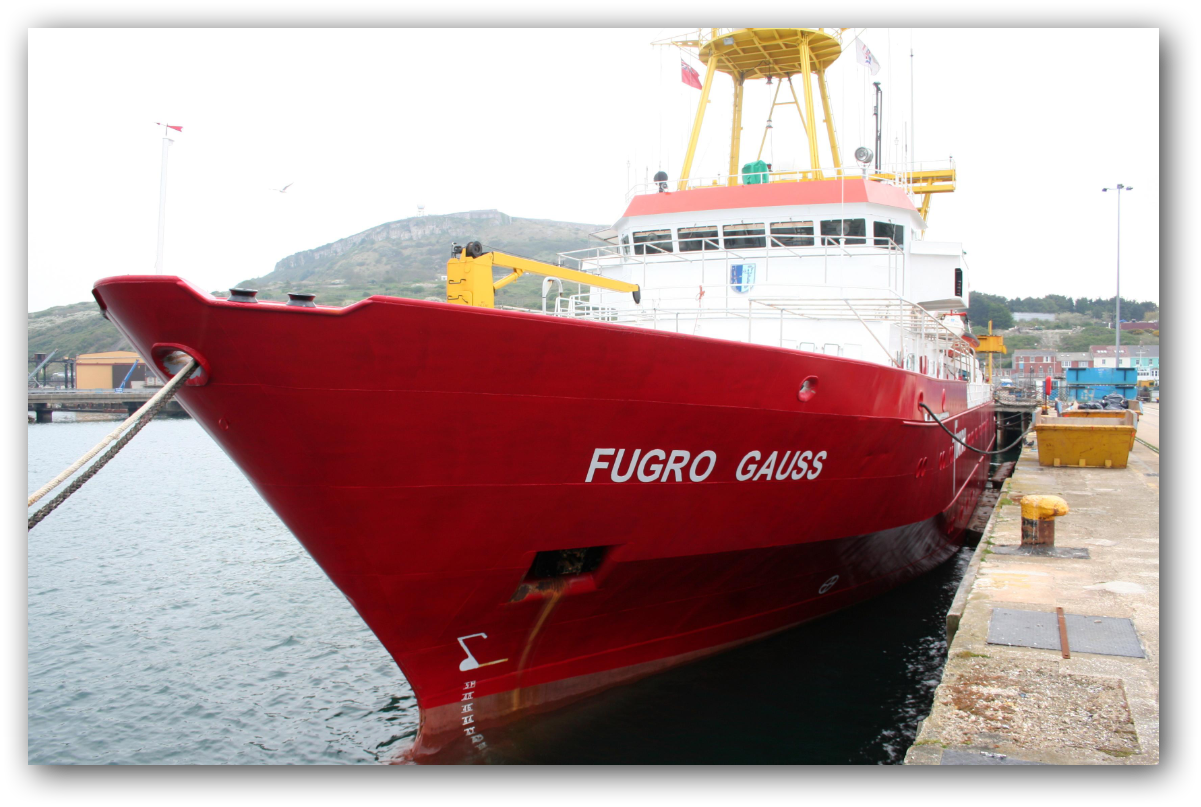
“The MV Faugro Gauss is expected to arrive at St Helena at 6am on Sunday, 18 August 2019, and will dock alongside of Rupert’s Jetty. The vessel is expected to stay in St Helena’s waters for two days.Notes: The MV Fugro Gauss will be surveying St Helena’s waters in order to assess the landing route for the Equiano submarine cable. This work is being undertaken as part of the Fibre Optic Cable Project, which will connect St Helena to high speed broadband in 2021.”
Over-The-Top (OTT) companies now dominate Undersea Cable Deployment
Meta’s (Facebook) Project Waterworth
On 14 February 2025, Meta announced a long -term major subsea cable called Project Waterworth. But it has not announced any timescales for transit of the South Atlantic.
Although Meta has not published a detailed timetable, the project is expected to take several years to complete, with industry estimates suggesting that the world’s longest subsea cable system could begin entering service around 2030. At more than 50,000 km in length, the project represents one of the most ambitious communications infrastructure programmes ever undertaken. By unlocking three entirely new oceanic corridors, the project aims to bring high-speed internet infrastructure to emerging markets and foster global economic cooperation.
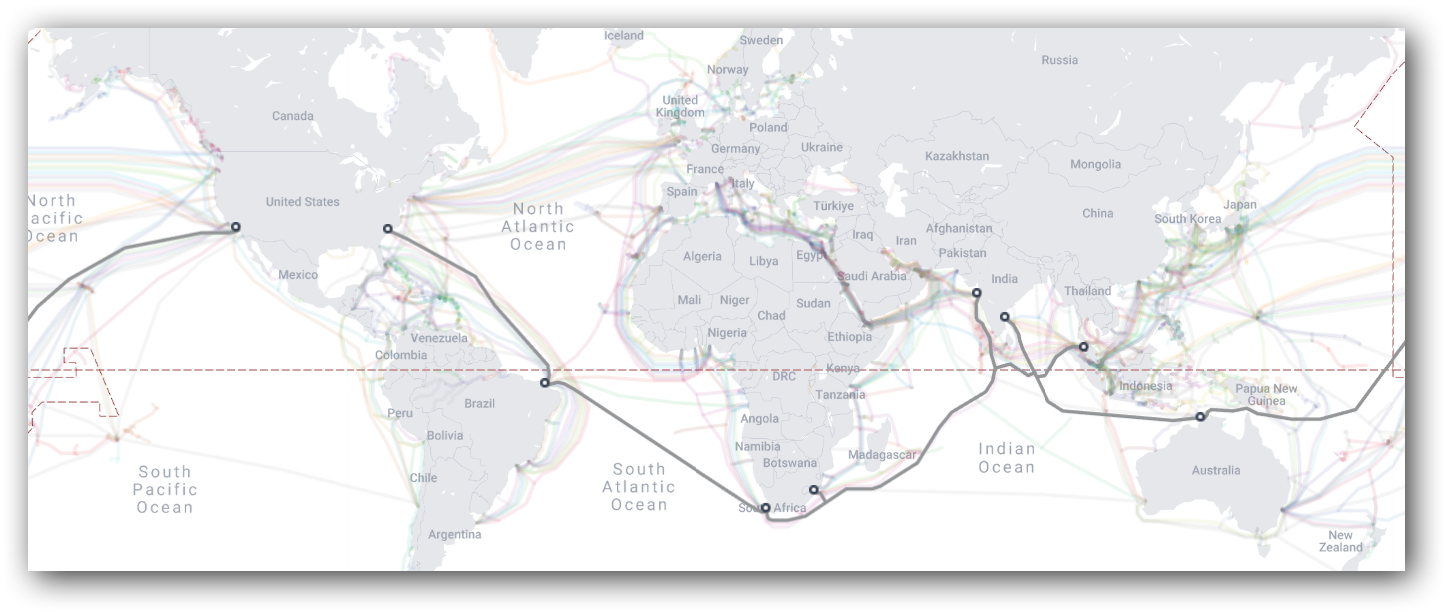
Although exceedingly exciting, I doubt that it has any relevance today to seeing the MV Fugro Supporter in the Falkland Islands. The South Atlantic link is just too far north, connecting to South America in northern Brazil. We should also not forget that the estimated cost of a 5,000km branch to the Falkland Islands would be US$75-100 million!
The Google Halaihai and Umoja cables
Still sticking to facts, anyone familiar with the South Atlantic telecommunications scene will be familiar with the Equiano cable discussed above, but may be less familiar with Google’s other undersea activities elsewhere in the world.
First, the Halaihai cable was announced in January 2024 as part of Google’s Central Pacific Connect initiative. The cable will link Guam and French Polynesia and, together with the companion Bulikula cable to Fiji, create a resilient ring network across the central Pacific. Construction activities are expected to extend over several years, with such projects typically requiring three to four years from announcement to service.
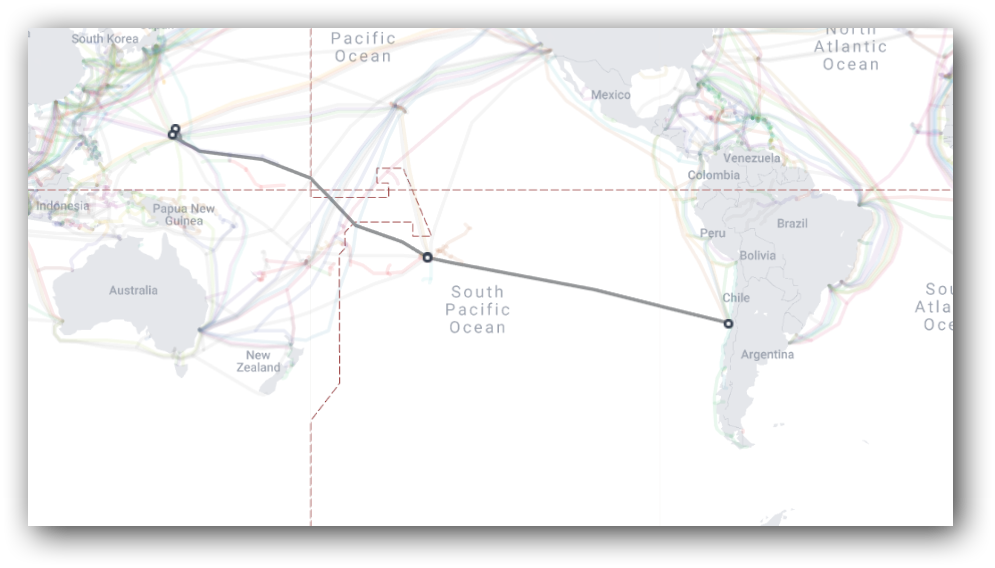
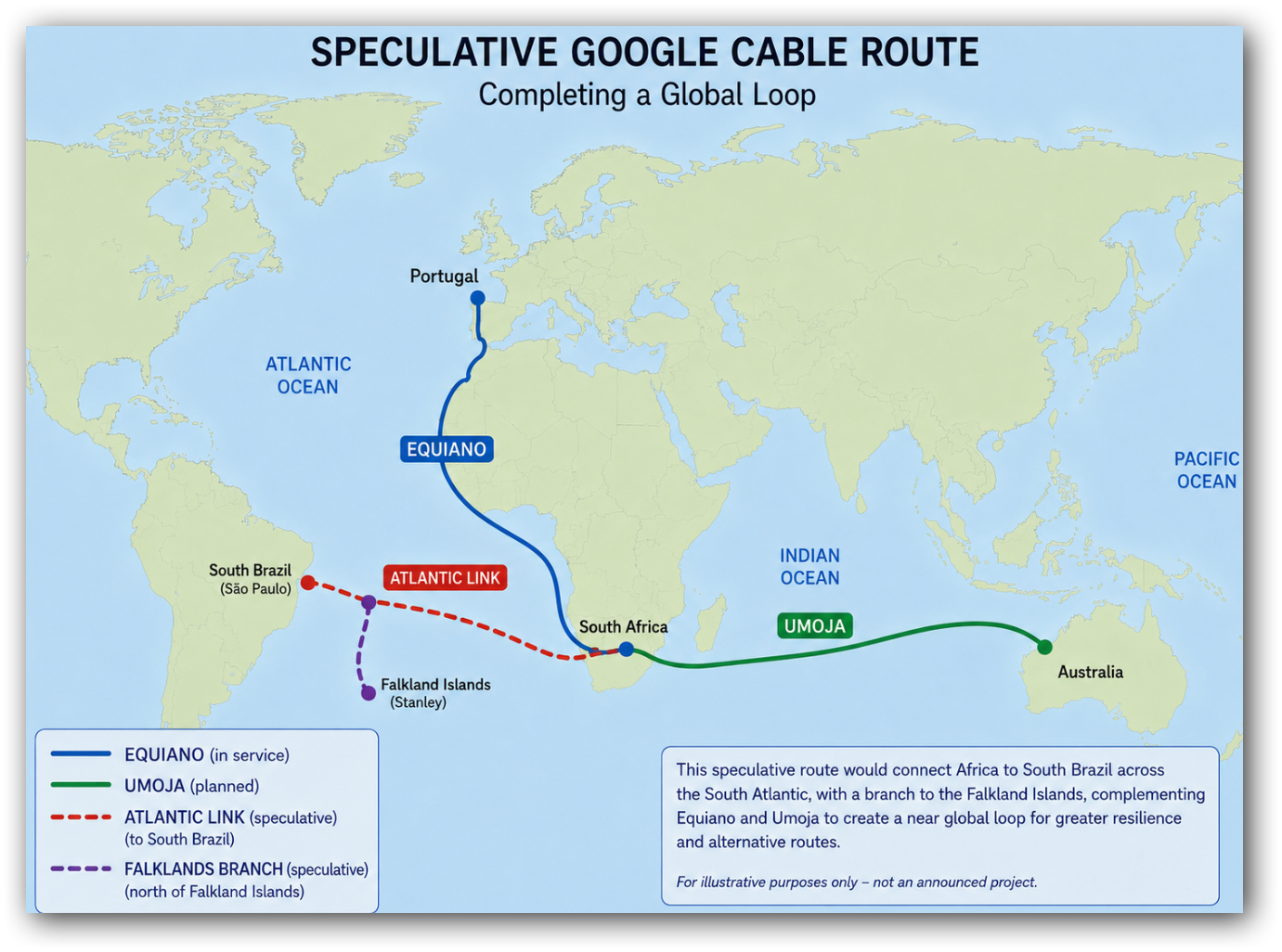
Google announced the Umoja cable in May 2024 as the first direct subsea connection between Africa and Australia. The cable will land in South Africa and Australia. Umoja forms part of Google’s Africa Connect initiative and complements the existing Equiano cable system. Current plans indicate that the system is expected to enter service in 2027, giving Google a second major route serving Africa and improving resilience between Africa, the Indian Ocean region and Australia.
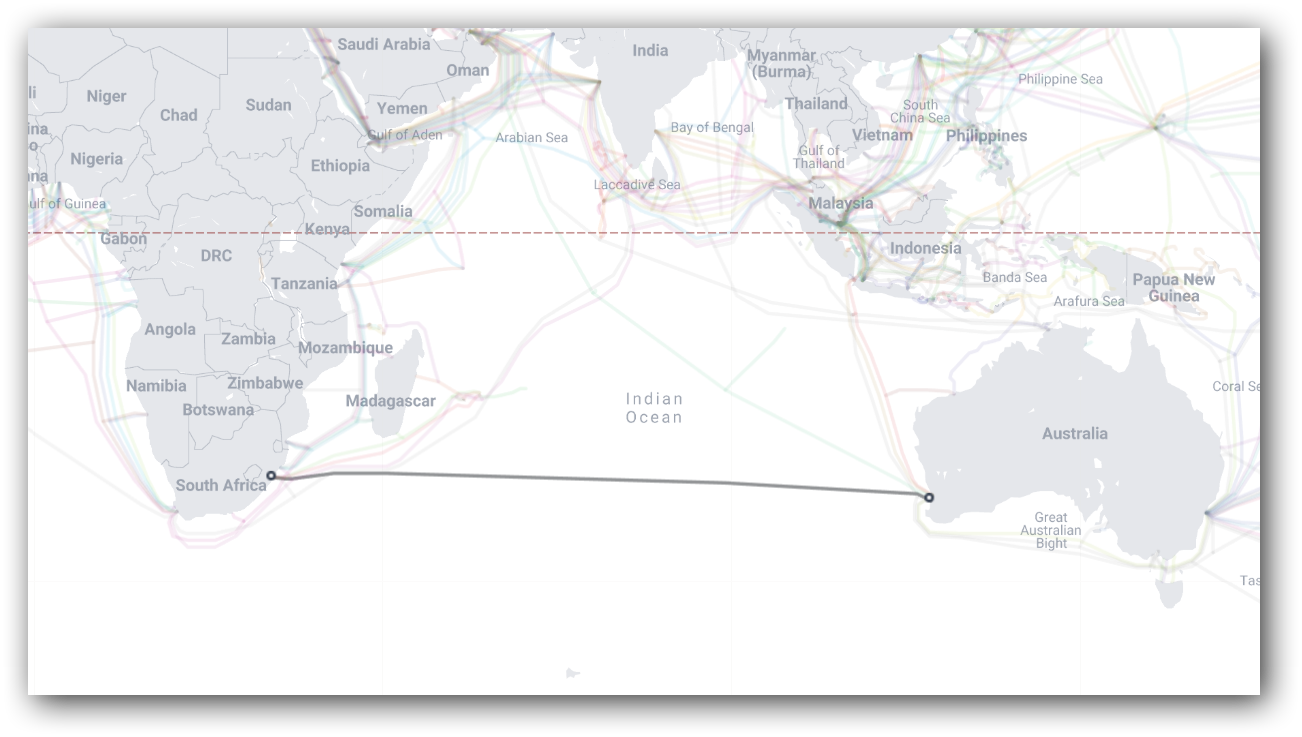
Google has demonstrated a willingness to include pre-positioned branching units in some of its cable systems, allowing additional island territories to be connected at a later date. There is no obvious reason why a similar approach could not one day be applied to the Falkland Islands.
Let’s now disappear down the rabbit hole and enter the Alice in Wonderland world of pure speculation.
Appendix: Other far South Atlantic initiatives
The Chile-Antarctic cable
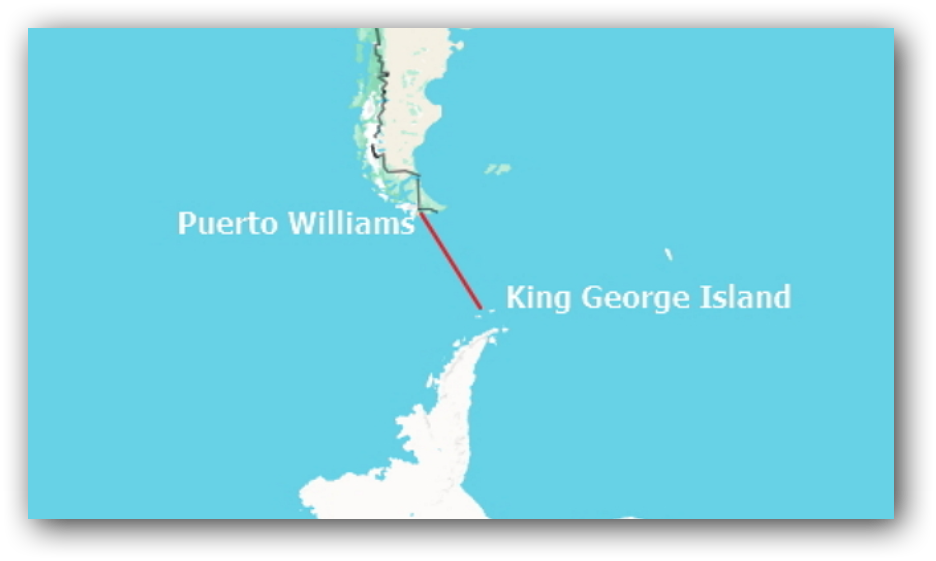
Though not particularly relevant to the Falklands today, for a number of reasons previously discussed on OpenFalklands (indeed, it was the subject of my first post in March 2019), it would be remiss not to mention the proposed Chile–Antarctica submarine cable. Announced on 25 July 2024 by Chile’s Undersecretariat of Telecommunications (SUBTEL), an agency of the Ministry of Transport and Telecommunications, the project would run approximately 1,000 km from Puerto Williams on the Beagle Channel to King George Island in Antarctica. It would use Chile’s existing Fibra Óptica Austral infrastructure in Puerto Williams.
The proposal attracted considerable international attention as it would represent the world’s first fibre-optic cable connection to Antarctica. However, despite the announcement and the commencement of feasibility studies, there has been little public evidence of progress towards route surveys or construction, and the project appears to remain at a very early stage.
SAEx (South Atlantic Express)
SAEx was a proposal for a cable linking South Africa, Namibia and South America, with branches to St Helena and Ascension Island. Despite considerable attention, the project has yet to materialise and appears dormant.
Chris Gare, OpenFalklands, June 2026, copyright OpenFalklands
2 Replies to “Could the South Atlantic Be The Next Cable Frontier?”