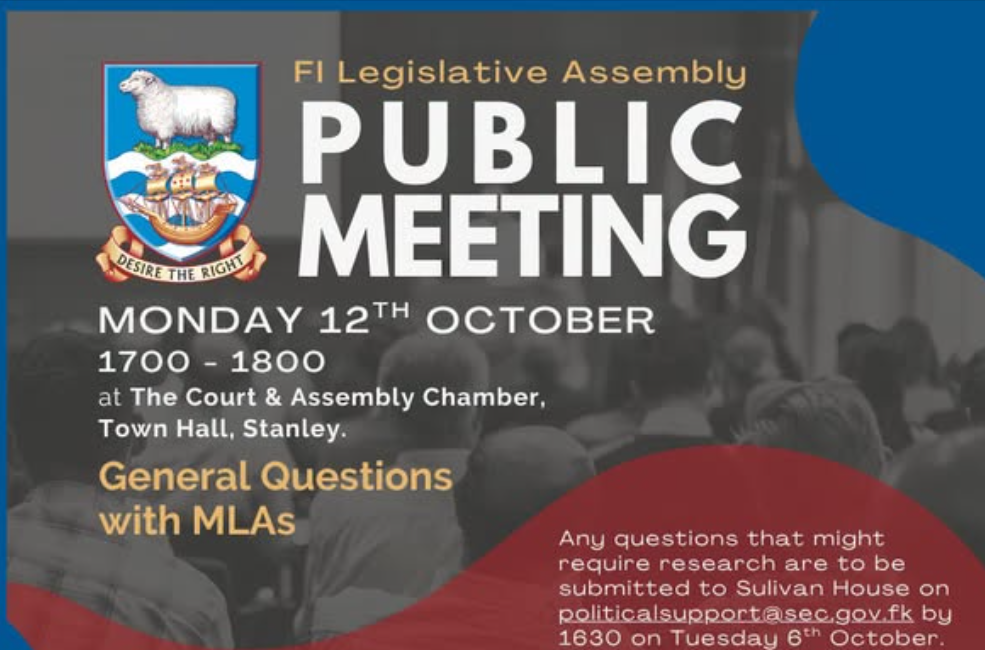
In response to Stephen Luxton’s questions, MLAs again confirmed that FIG intends to give Sure notice. But they also disclosed something that, as far as I am aware, has not been made public before. The telecommunications paper ExCo considered in August set out parameters for both giving notice and future market engagement. Those parameters have apparently not yet been met because of “recent geopolitical events.” That is an important development.
It means the delay is no longer simply an unexplained gap between the completion of the telecommunications consultancy work, the August ExCo discussion and the promised international market process. FIG has now identified a specific reason why it believes it is not yet appropriate to give notice. However, we have not been told which “geopolitical events” are driving this, which parameters have not been met, or what must happen before FIG considers it safe to proceed.
What MLAs Said (Credit: Falklands Radio)
Stephen Luxton asked:
MLAs considered a paper on the future of telecommunications at the August ExCo meeting, and said that public information would be put out. Six weeks have since passed and nothing appears to have been released. Will MLAs please either give an update on the content and outcome of this decision, or commit to a timeline for when such an update will be provided, and clarify what the reason is for the delay?
The response by MLA Roger Spink was:
As the public is aware, FIG has already confirmed that it intends to give notice to Sure at a point where future market engagement can be carried out to make best use of the two-year notice period. MLAs have committed to prioritising continuity and security of telecoms services. This includes services to the public and also the importance of local telecoms staff and their expertise and knowledge.
The paper considered in August set out parameters for both the giving of notice and future market engagement. Recent geopolitical events mean that these parameters have not yet been met. Officers are working on ways to reach that point and are in regular contact with Sure to make certain that both organisations are in the best possible position to work together effectively once notice is given. MLAs realise that this is a frustrating situation. It is frustrating for all involved, but hope the public will understand the need for prudence when dealing with one of our most valuable national utilities.
Is FIG Still Going to Give Notice?
Stephen then asked the more direct question:
As a result of the delay in giving notice to Sure South Atlantic Limited, which was originally expected for December last year, Starlink users are now going to be required to pay almost a full extra year of the VSAT licence fees to FIG. Is the Falkland Islands Government still intending to give notice to Sure South Atlantic? Why, given that the requirement for two years’ notice was clearly understood several years ago, has this been so badly delayed?
After responding to the point about VSAT licence fees, the answer returned to the central issue:
As outlined above, giving notice before the conditions for international market engagement [have been met] would be foolhardy. It is FIG’s intent to give notice and to work constructively with Sure on transition.
That last statement is important. FIG has again explicitly said that it intends to give notice. But it has also introduced what appears to be a new prerequisite: meeting the conditions necessary to engage in the international market first.
This comment—“As outlined above, giving notice before the conditions for international market engagement [have been met] would be foolhardy”—is difficult to reconcile with what has already happened. At FIG’s request, Cambridge Management Consultants went to the international telecommunications market toward the end of 2025 specifically to test market interest and see whether other operators might be interested in the Falkland Islands.
A recording of the questions may be heard here:
How Did We Get Here?
The table below puts tonight’s public meeting statement into context. FIG announced in October 2024 that it had appointed Cambridge Management Consulting to examine the existing telecommunications environment and future requirements. That was followed by consultation, public meetings, preliminary market engagement, completion of the consultants’ work and several ExCo discussions. The contractual two-year notice window opened at the beginning of 2026. Notice has still not been publicly confirmed.
| Date | FIG / MLA event | Why it matters | Months since review began |
|---|---|---|---|
| 2 Oct 2024 | FIG announces Cambridge Management Consulting’s (CMC) appointment following an international tender. Phase 1 reviews the existing telecommunications environment and future requirements. | Formal start of the post-2027 review process. | 0 months |
| Late 2024–early 2025 | CMC undertakes Phase 1, including consultation and visits to the Islands. | Gather evidence and assess future options. | 0–5 months |
| 25 Mar 2025 | CMC holds its public meeting at Stanley Town Hall. Tim Passingham discusses the importance of choice and non-exclusivity. | First substantial public presentation of CMC’s emerging thinking. | ≈ 6 months |
| 16 Jul 2025 | MLA Mark Pollard discusses future telecommunications work in the Legislative Assembly, including the workstream on “what happens post licence Sure.” | Formal Assembly acknowledgement of the end-of-licence programme. | ≈ 9½ months |
| Sep 2025 | CMC Phase 2 / Preliminary Market Engagement (PME) begins. | Moves from general analysis towards testing market interest and practical post-2027 options. | ≈ 11 months |
| Late 2025 | CMC conducts engagement with potential operators and providers. | Tests whether alternative market structures and operators are realistically available. | ≈ 12–14 months |
| Jan–early 2026 | CMC completes its Phase 2 work and final report for FIG. | FIG now has the consultancy work required to make the major policy decisions. | ≈ 15–16 months |
| Jan 2026 | The contractual two-year notice window opens before the licence ends on 31 December 2027. | Notice can now be served while preserving the full two-year period. | ≈ 15 months |
| 17/24 Mar 2026 | ExCo considers a closed FIG paper entitled “Future of Telecommunications.” | First identifiable ExCo consideration following completion of the CMC work. | ≈ 17½ months |
| Spring 2026 | FIG indicates that further ExCo consideration will be necessary. | No final decision or publicly confirmed notice yet. | ≈ 18–20 months |
| 27 May 2026 | CMC are confirmed as no longer involved in the project. | FIG now has responsibility for turning the consultancy work into policy and implementation. | ≈ 20 months |
| 29 Jun 2026 | Connected Falklands Group asks MLAs for a Select Committee to scrutinise the future telecommunications proposals. | Attempt to introduce public Assembly-level scrutiny before the major strategic decision. | ≈ 21 months |
| Jun–Jul 2026 | MLAs decline the Select Committee request but indicate that stakeholders will have opportunities to understand and comment on future proposals. | Public and stakeholder consultation becomes the expected scrutiny mechanism. | ≈ 21–22 months |
| 12 & 25 Aug 2026 | ExCo considers another closed “Future of Telecommunications” paper and agrees “the next stage of planning.” Work will begin on shaping future market models, and FIG promises public engagement. | The process advances, but the final market structure remains unresolved. | ≈ 22½ months |
| Sep 2026 | FIG CEO Andrea Clausen states that FIG “still intends to give notice to Sure and to run an international process to decide on the future of telecommunications in and for the Falkland Islands.” | Clearest public statement of FIG’s intended route beyond the current exclusive licence. | ≈ 23 months |
| 17 Sep 2026 | MLA Jack Ford says the August ExCo paper discussed issuing notice to Sure, its timing and the process around it, although he cannot say whether notice has been given. | Confirms that the critical notice question was explicitly considered by ExCo. | ≈ 23½ months |
| 12 Oct 2026 | No public confirmation that notice has been served. Detailed public consultation on the future market model has still not taken place. | The two most important visible next steps — notice and public consultation — remain outstanding. | ≈ 24½ months |
The timeline is useful because it shows that this is not simply a six-week delay following the August ExCo meeting. The formal review of what happens after the current licence began roughly two years ago. That does not mean that every month represents avoidable delay. Telecommunications is critical national infrastructure, and FIG is right to consider continuity, resilience, staff and the risks involved in transition. But that makes tonight’s explanation particularly important.
The Question Has Changed
Until tonight, the obvious question was: Why hasn’t FIG given notice to Sure?
We now have at least part of the answer. FIG says the August ExCo paper set parameters for giving notice and engaging with international markets, and that “recent geopolitical events mean that these parameters have not yet been met.” But telecommunications does not stand still. Technology, markets and operating conditions can change dramatically in a matter of months. In my experience, that is one of the dangers of multi-year studies and decision-making processes: the assumptions on which they began can already be changing by the time decisions are finally ready to be made. That is the real danger of the current situation.
FIG has not explained which recent geopolitical events it is referring to, what parameters remain unmet, or what needs to change before the process can move forward.” So the question has changed from simply why the delay? to what has happened that is preventing FIG from proceeding?
One possibility I have already been considering is that recent developments in St Helena, its new telecommunications arrangements with Sure as discussed in a recent post, and the developing MoU relationship between FIG and the St Helena Government raise the question of whether events elsewhere in the South Atlantic could be influencing FIG’s thinking — and whether FIG may ultimately move towards a broadly similar strategy for the Falklands.
That remains speculation. Nothing said at tonight’s meeting establishes that connection. But FIG’s unexplained reference to “work together effectively once notice is given.” makes the possibility considerably more interesting.
That will be the subject of my next OpenFalklands post.
Chris Gare, OpenFalklands, October 2026, copyright OpenFalklands